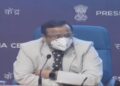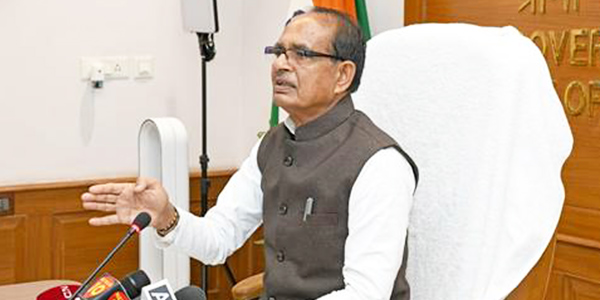
Union Minister for Rural Development and Agriculture & Farmers’ Welfare, Shivraj Singh Chouhan today informed the media about the achievements of the Ministry of Rural Development. Shri Chouhan said that giving complete justice to half of the population and empowering women is our primary goal. Union Minister Shri Chouhan stated that this year, the ministry’s budget was Rs. 1 lakh 84 thousand crores, of which Rs. 1 lakh 3 thousand crores have been spent. We are working day and night to fulfill the Prime Minister’s resolution by connecting rural communities with employment opportunities and essential facilities. While answering media queries, Chauhan stated that if any state identifies shortcomings in MNREGA and PM Awas Yojana, action will be taken, reaffirming the government’s commitment. He emphasized that schemes like MNREGA are demand-based, and if the allocated budget falls short, additional funds are sought from the Finance Ministry based on state demands, with continuous revisions made accordingly.

Shivraj Singh Chouhan highlighted the Ministry’s key achievements, which include:
- Pradhan Mantri Awas Yojana – Gramin
- Shivraj Singh Chouhan informed that under the Pradhan Mantri Awas Yojana – Gramin, a target of constructing 2.95 crore houses was set by March 2024, out of which almost all houses have been sanctioned, and 2.67 crore houses have been completed.
- Recognizing the success of this program and the need for rural housing, the scheme has been extended, and 2 crore additional houses will be constructed over the next five years.
- These 2 crore new houses will be built at an estimated cost of more than ₹3.06 lakh crore. To ensure no eligible family is left out of the scheme’s benefits, the exclusion criteria have been revised from 13 to 10. Exclusions such as owning a mechanized fishing boat, refrigerator, or landline phone have been removed. Additionally, the income threshold for exclusion has been increased from ₹10,000 to ₹15,000 per month. The government has taken this decision after consultations with stakeholders, removing unnecessary conditions to truly achieve the goal of housing for all. A comparison of old and new exclusion criteria is attached.
- Chouhan informed that the government’s goal in uplifting rural India is not just to provide housing but also to ensure basic amenities in these homes. Beneficiaries are provided with 90–95 days of wage support under MGNREGA for constructing their homes. Integration with other welfare schemes such as Swachh Bharat Mission, Ujjwala Yojana, and Saubhagya Yojana ensures facilities like toilets, cooking gas, and electricity. Moreover, under the Pradhan Mantri Surya Ghar: Free Electricity Scheme, solar rooftop connections are provided to beneficiaries, reducing their electricity bills. Every house built under this scheme is a complete home with all essential facilities. Truly, this scheme lays the foundation for poverty-free villages and a developed India.
- Out of the newly approved target of 2 crore houses, approximately 38 lakh houses have been allocated to 18 states, and ₹10,668 crore in funds has been released to these states. There is no shortage of funds for this scheme. States are requested to release their share promptly, utilize the funds, and send proposals for the next installment to receive the central government’s share.
- The minimum house size has been set at 25 square meters, including a clean cooking area. Financial assistance of ₹1.20 lakh in plain areas and ₹1.30 lakh in north eastern and hilly states is provided. Payments are efficiently made through Direct Benefit Transfer (DBT). This year, over 10 lakh beneficiaries received their first installment in a single click by the Prime Minister Narendra Modi in Bhubaneswar.
- On 17th September 2024, the Prime Minister Modi issued approval letters for 15 lakh houses and released ₹3,180 crore as the first installment for over 10 lakh beneficiaries via Aadhaar-based transfers. Additionally, more than 26 lakh houses were handed over to their owners.
- Pradhan Mantri Awas Yojana – Gramin is not just a scheme; it is a beacon of hope for the common people, a foundation for dignity, empowerment, and a better future. It reflects the Government of India’s unwavering commitment to rural development and progress.